

Physiotherapy exercises
These are some exercises that may help specific difficulties your child is experiencing, for example, stretching particular muscles, strengthening core muscles, developing balance. These are just ideas, you can make them into your own fun versions using your child’s favourite toys, songs or games.
Physiotherapy exercise examples
Bridging
Position yourself lying on your back with your knees bent up and feet flat. Practice lifting your bottom up and rolling a ball or toy car underneath you from one side to the other. Use your arms on the floor for support if needed, and keep your knees hip width apart.
To make it harder: Hold for up to 10 seconds. Cross one leg over the other then bridge, keeping your hips level.
Crab-walking
Position yourself on your hands and feet facing upwards with your bottom lifted off the floor (bridge position). Practice `crab-walking` sideways without touching your bottom on the floor.
To make it easier: Start by practicing bridging only, move slowly.
To make it harder: Practice `crab-walking` in different directions or move faster.
Bear walking
Position yourself on your hands and feet with your bottom in the air. Bear-walk forwards along the floor.
To make it harder: Practice “bear-walking” in different directions or go faster or further. Race to see who can reach a ball or toy placed between you first.
Slow squatting
Position yourself standing with a chair behind you. Start with your knees straight. Bend your knees and stick your bottom out backwards to hold a squat for a count of 5 seconds. Keep your back straight and your heels on the floor and your weight equally through both legs. Then slowly stand up again.
To make it easier: Hold on for balance
To make it harder: Hold the squat for longer or hold a weight while squatting. Try squat walking side to side.
Wall slides
Position yourself standing with your back against a wall and both feet a little away from the wall. Practice bending and straightening your knees to slide your back up and down the wall. Ensure that your feet and knees are held together, your knees do not lock back past straight and both of your feet point forwards.
Lower so your thighs are parallel to the floor. Hold as long as possible.
To make it easier: Do a smaller bend
To make it harder: Do a deeper slide, hold for 5 to 10 seconds. Then try the wall slide challenge, hold for as long as possible!
Half kneeling
Position yourself in half-kneeling, kneel up tall then bring one leg in front so your foot is on the floor, with a 90 degree angle at the ankle, knee and hip. Practice maintaining this position while doing activities, for example, throwing and catching, “Simon says” copying a range of actions, popping bubbles.
To make it harder: Start in a standing position and lower down to half kneeling before playing. Or start in your half kneeling position and stand up with control.
Lunges
Position yourself in standing with one leg comfortably in front. Lower down, ensuring that your back knee drops towards the floor and that your front knee does not come beyond your toes.
Walking on heels
Stand on your heels and walk forwards without letting your toes touch the floor
To make it harder: Walk on your heels in different directions, take bigger steps or carry something while you are doing the activity,
To make it easier: Hold on to something to balance
Movement activities and exercisesThese are leg stretches that you do for yourself. These work well because your body weight helps the muscle to stretch. If you are not able to do these yourself, please check out the section called “passive lower limb stretches”.
Calf (back of lower leg) stretch
Option A
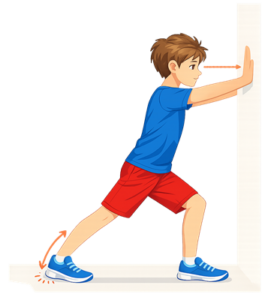
- Stand in a lunge position facing a wall with one leg straight behind and the other leg in front with the knee bent.
- Make sure both heels are down and feet are pointing forwards.
- Slowly lean forwards towards the wall, allowing the front knee to bend but keeping the back heel on the floor. You should feel a stretch in your calf muscle at the back of your lower leg and/or around the heel.
- Hold for a slow count of 20, then repeat 3 times.
Option B
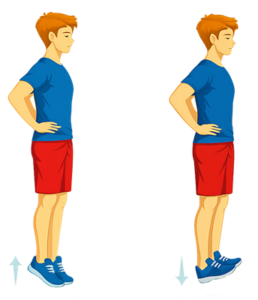
- Stand on the bottom step of a set of stairs with your heels off the edge of the step and holding onto a banister.
- Slowly rise up onto your toes as high as possible and then drop them back down so that your heels are lower than the step level. You should feel a stretch in your calf muscle at the back of your lower leg and/or around the heel.
- Hold for a slow count of 20, then repeat 3 times.
Deep calf muscle stretch (soleus)
Position yourself standing with one leg in front of the other and your hands resting on a wall. Keep both of your knees bent. Ensure that both feet point forwards and your back heel remains on the ground.
Hold for 20 to 30 seconds. Repeat 3 to 5 times.
This video shows how to do this type of exercise:
Hamstring (back of thigh) stretch
Option A
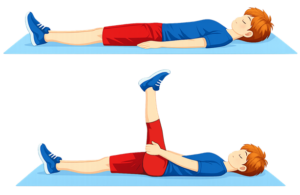
- Lying on your back, keep one leg straight and bend the other leg until it is at a right angle with your body (at 90 degrees).
- Slowly raise your lower leg towards the ceiling as far as you are able. You should feel a stretch at the back of your knee or thigh.
- Hold for a slow count of 20, then repeat 3 times.
Option B
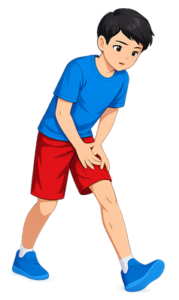
- In standing, place one leg straight in front and lift your toes up.
- Bend your knee on the back leg and lean forwards over the front straight leg. You should feel a stretch at the back of your knee or thigh.
- Hold for a slow count of 20, then repeat 3 times.
Hamstring stretch in long sitting
- Position yourself sitting against a wall with your legs out in front of you and your back straight.
- Ensure that your knees are kept straight and your feet point upright.
Hold for 15 to 20 minutes.
One-sided hamstring stretch in long sitting
- Position yourself sitting with one leg out straight in front of you and the other leg bent out to the side.
- Lean forward while keeping your leg and back as straight as possible.
Hold for 20 to 30 seconds. Repeat 3 to 5 times.
Hip adductor and hamstring combined stretch (wide-legged long sitting)
- Position yourself sitting against a wall with your legs out in a “V”, keeping your back straight.
- Ensure that your knees are kept straight and your feet point upright.
Hold for 15 to 20 minutes.
Quadriceps (front of thigh) and hip flexor (front of hip) stretch
Option A
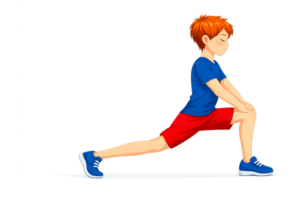
- Stand holding onto a firm surface or chair, keeping your body upright, bend one knee behind you and hold onto the foot.
- Slowly bring the foot towards your bottom; making sure your hips are pushed forwards and straight. You should feel a stretch at the front of the thigh.
- Hold for a slow count of 20, repeat 3 times.
Option B
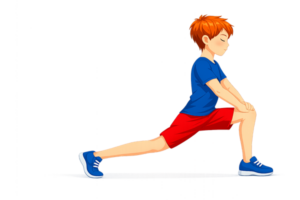
- Position yourself in a low lunge with front knee bent and back leg straight.
- Push your hips forward until you feel a stretch at the front of your hip or thigh on the straight leg.
- Hold for a slow count of 20, repeat 3 times.
Option C
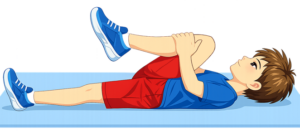
- Lying on your back, keep one leg straight and bend the other leg, bringing it up towards your tummy.
- Make sure you keep the other leg straight.
- Hold for a slow count of 20, repeat 3 times.
Option D
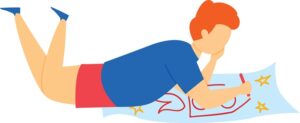
- Lay on your tummy to look at a book or computer tablet, draw or play a game.
- Do this for at least 20 minutes each day.
Hip adductor (inside of thigh) stretches
Option A
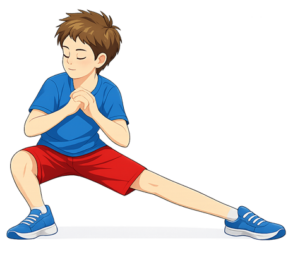
- In a standing position, step one leg out to the side and bend the opposite knee to squat down.
- Lean towards your bent leg.
- Hold for a slow count of 20, repeat 3 times.
Option B
- Position yourself sitting with your hips and knees bent to each side and your feet together. Push your knees gently towards the floor with your elbows.
These are stretches that someone else helps you with, for example, for younger children or for children who are not able to stand and stretch. Where there is more than one option to stretch a muscle, pick your favourite.
Assisted gastrocnemius (upper calf muscle) stretch
- Position the child lying on their back with your hand stabilising their knee.
- Place your other hand around the child`s heel with your palm along the length of the foot and gently push the foot upwards.
- Ensure that the ankle does not roll in or out.
- Apply the stretch using a gentle pressure.
Hold for 20 to 30 seconds. Repeat 3 to 5 times.
This video shows how to do this stretch:
Assisted soleus (deep calf muscle) stretch
- Position the child lying on their back with their knee bent.
- Place your hand around the child’s heel with your palm along the length of the foot and gently push the foot upwards.
- Ensure that the ankle does not roll in or out.
- Apply the stretch using a gentle pressure.
Hold for 20 to 30 seconds. Repeat 3 to 5 times.
This Paediatric therapy video shows how to do this stretch
Assisted hamstring (back of thigh) stretch
- Position the child lying on their back with their hip and knee bent.
- Support their upper leg with your hand.
- Apply a gentle upwards pressure to the lower leg to straighten the knee as much as possible.
- Apply stretch using gentle pressure.
Hold for 20 to 30 seconds. Repeat 3 to 5 times. Repeat on the other leg if needed.
Calf stretchesOption A: Assisted hip adductor stretch in sitting
If your child has good sitting balance, position them sitting in between your legs with their hips and knees bent out to the sides and the soles of their feet together. Apply a gentle downwards pressure to their knees. Encourage them to reach up and out, for example, for bubbles.
Hold for 1 minute, 3 times.
Option B: Assisted hip adductor stretch in lying
Position the child lying on their back with their legs bent up so their knees point at the ceiling. Apply a gentle outwards pressure at the knees to open up the hips.
Hold for 1 minute, repeat 3 times.
Progressions and variations
More advanced: 1. Place a rolled up towel under the knees for support. More advanced: 1. Place a weight on the knees.
Precautions
- Impaired or absent sensation of stretch.
Hold for 1 minute, 3 times.
Hip flexor stretch in half-kneeling
Aim
To stretch or maintain range in your hips.
Instructions
Position yourself kneeling on one knee with your other knee bent in front of you. Lean forwards at your hips, keeping your trunk and head upright.
Progressions and variations
Less advanced:
- Provide hand support for balance.
- Decrease forwards lean at the hips.
More advanced:
- Increase forwards lean at the hips.
Precautions
- Impaired or absent sensation of stretch.
Hold for 20 to 30 seconds. Repeat 3 to 5 times.
Hip flexor stretch lying on tummy
Option A
- Lying on your tummy, look at a book or computer tablet, draw or play a game.
- Do this for at least 20 minutes each day.
Option B
- Lying on your tummy, stabilise your child’s hips.
- Holding one leg under the knee, lift the thigh off the floor while keeping the hips level.
Read more on exercises to stretch and strengthen the spine