


Accessibility and language tool guide
Skip to content
Leeds Community Healthcare NHS Trust Logo
Careers Contact Us
  • Home
  • Our services (A to Z)
  • About us
    • Access to information
    • Equality and diversity
    • Research
    • Awards
    • Infection prevention and control
    • Clinical and medical education and training
    • Board of directors
    • Working in partnership
    • Safeguarding children and adults
    • Charity
    • Sustainability
  • News
  • Join our team
    • Why work for us?
    • Flexible staff
    • Newly qualified graduates
    • Vacancies
    • Apprenticeships
    • Working and living in Leeds
  • Patient experience and engagement
    • Compliments, comments and complaints
    • Your feedback and experience
    • Person-centred care
    • Get involved
    • Thinking about using a camera or other equipment to monitor someone’s care?
    • Help to access and attend your appointment
    • About Me project
  • Contact us
    • Plan your journey
    • Location finder
    • Press and media enquiries
Skip to content
Leeds Community Healthcare NHS Trust Logo
  • Home
  • Our services (A to Z)
  • About us
    • Access to information
    • Equality and diversity
    • Research
    • Awards
    • Infection prevention and control
    • Clinical and medical education and training
    • Board of directors
    • Working in partnership
    • Safeguarding children and adults
    • Charity
    • Sustainability
  • News
  • Join our team
    • Why work for us?
    • Flexible staff
    • Newly qualified graduates
    • Vacancies
    • Apprenticeships
    • Working and living in Leeds
  • Patient experience and engagement
    • Compliments, comments and complaints
    • Your feedback and experience
    • Person-centred care
    • Get involved
    • Thinking about using a camera or other equipment to monitor someone’s care?
    • Help to access and attend your appointment
    • About Me project
  • Contact us
    • Plan your journey
    • Location finder
    • Press and media enquiries
Leeds Community Healthcare NHS Trust Logo
/Our services (A to Z)/0 to 19 public health integrated nursing service (0 to 19 PHINS)/Pregnancy and your new baby/Supporting your baby’s development
Hero Banner Background

Supporting your baby’s development

This page is for parents and carers that want simple, practical ideas to support their baby's development at home.

baby and mother playing

Information on supporting your baby's development

Your baby is growing, learning and changing every day.

Every baby develops at their own pace, these ideas are here to help you support their early development in a gentle, relaxed way.

Reach and roll

Getting help if you’re worried

If you’ve tried the activities regularly and have concerns about your baby’s development you:

  • will have your baby’s routine visits (new birth, 6 to 12 week, 9 to 12 month development review) where you can discuss any questions or worries.
  • can also speak to your GP or your midwife.
  • can speak with someone from the 0 to 19 service before we visit, find our details in the contact us section on this page.

Supporting information

Communication

How your baby understands and shares information using sounds, words, gestures, or other ways to communicate.

  • Talk and interact with your baby: Talk softly during feeding, changing and play. Your baby learns by hearing your voice. Visit BBC Tiny Happy People: When do babies make eye contact? (How does eye contact benefit new born babies?)
  • Play face‑to‑face games: Smile, sing or make gentle sounds for your baby to watch and copy.
  • Support early communication: Copy your baby’s cooing and gurgling, then pause so they can respond. Visit BBC Tiny Happy People: How cooing with your baby can help language development
  • Sing songs and nursery rhymes: Repetition helps your baby learn rhythm and early sound patterns. Read more on nursery rhymes and songs
  • Share books together: Look at simple picture books with bold images. Your baby loves hearing your voice.
  • Dad and baby reading

Gross motor skills

How your baby uses the big muscles in their body to move, play, and get around.
baby smile

  • Encourage movement and tummy time: Short, supervised tummy time builds neck, shoulder and upper‑body strength. Visit BBC Tiny Happy People: How to do tummy time with your new born baby
  • Explore gentle sensory play with movement. Soft swaying, supported stretching or gentle body movement helps babies learn how their bodies work. Visit BBC Tiny Happy People: Sensory play inspiration for new-borns, toddlers and pre-schoolers

Fine motor skills

How your baby uses their hands and fingers to hold, pick up, and handle small objects.

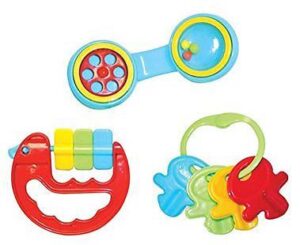
  • Use everyday objects for play: Offer safe items like a soft mirror, rattle or puppet to help your baby practise grasping and tracking movement. Visit BBC Tiny Happy People: Fun game to play with new-borns (What’s in the bag?)
  • Sensory play: Let your baby feel soft textures such as fabrics or smooth objects. This builds early hand and finger control.

Problem‑solving skills

How your baby learns, explores, and works things out during play and daily activities.

  • Use everyday objects for exploration: Babies learn by looking, touching, shaking and exploring safe objects. Visit BBC Tiny Happy People: Fun game to play with new-borns (What’s in the bag?)
  • Early sensory exploration: Let them explore how things feel, sound or move to help them understand cause and effect.
  • Tummy time exploration: Reaching for toys during tummy time encourages problem‑solving through trial and error.

Personal–social skills

How your baby begins to connect with others and shows their needs and feelings.

  • Play face‑to‑face games: Helps with bonding, connection and early social skills. Visit BBC Tiny Happy People: Face fun challenge
  • Talk and interact during daily routines: Feeding, cuddling and nappy changes help your baby feel safe and connected.
  • Share books and nursery rhymes together: Helps develop turn‑taking, attention and connection with adults. Visit BookStart: Activities for 1 year olds and under

Want more ideas? See our useful links section.

These ideas are based on the ages and stages questionnaires (ASQ) activity suggestions. They are simple things you can do at home to help your baby learn, communicate, and explore.

Communication

How your baby understands and shares information using sounds, words, gestures, or other ways to communicate.

  • Sing songs and nursery rhymes
    • Use simple songs or lullabies during play or settling.
    • Repetition helps your baby learn rhythm, sounds, and early words. Read more on nursery rhymes and songs
  • Read books or magazines together: Point to pictures and name what you see while your baby turns pages. Visit BBC Tiny Happy People: Read all about it
  • Pointing and naming: Show your baby everyday objects and label them as they point or reach. Visit BBC Tiny Happy People: Pointing out and naming things for baby

Gross Motor skills

How your baby uses the big muscles in their body to move, play, and get around.

  • Find a big box your baby can crawl in and out of: Encourage your baby to explore by crawling through large boxes or tunnels (Always under adult supervision) Visit BBC Tiny Happy People: Playing games with a box

Fine Motor skills

How your baby uses their hands and fingers to hold, pick up, and handle small objects.

  • Let your baby feed themselves: Offer safe finger foods so your baby can practise picking up small pieces and exploring textures. Visit NHS Best Start in Life: Feeding your baby
  • Exploring objects and banging toys: Give safe household items like wooden spoons or blocks so your baby can explore sounds and practise holding objects. Visit BBC Tiny Happy People: Exploring sounds with babies

Problem‑solving skills

How your baby learns, explores, and works things out during play and daily activities.

  • Play hide‑and‑seek with toys: Hide toys under a cloth or behind objects for your baby to find. Visit BBC Tiny Happy People: Toy hide and seek

Personal–social skills

How your baby begins to connect with others and shows their needs and feelings.

  • Imitation games like Peekaboo: Repeat simple games so your baby can copy actions and learn through turn‑taking.
  • Sing and share stories together: Helps with bonding, attention and early social communication. Visit BBC Tiny Happy People: Why sing songs with actions like ‘Wheels on the Bus’?

When to stop using bottles

It is recommended to stop using bottles and teats from 12 months old and move to an open cup or free‑flow cup.

Why this matters

  • Bottles can cause tooth decay, especially if used for milk or sugary drinks.
  • Long‑term bottle use can affect mouth development and speech.
  • Learning to sip from a cup is better for teeth and helps your child develop new skills.

Tips to help your child move to a cup

  • Start offering sips of water from a cup from around 6 months, especially with meals.
  • Choose an open cup or free‑flow cup (with no valve).
  • Expect some mess at first, this is normal and part of learning.
  • Keep bottles for milk only and aim to phase them out completely by 12 months.
  • Give lots of praise for trying the cup.

When to stop dummy use

The NHS recommends starting to reduce dummy use from around 6 months, with the aim to stop between 6 to 12 months.

This helps reduce long‑term issues with teeth and speech.

Why this matters

  • Dummies can change how children’s teeth grow.
  • They can stop the tongue from moving freely.
  • When a child has a dummy in their mouth, it is harder to babble, chat and practise new sounds. Helping them give it up gives them more chances to talk and build language skills.

Top tips for reducing dummy use

  • Keep the dummy for sleep times only.
  • Offer other comfort items, a teddy, blanket, or extra cuddles.
  • Take the dummy out when your child is making noises or trying to chat.
  • Wait until your child asks for the dummy instead of giving it automatically.
  • Be consistent and give lots of praise.
  • Try a sticker chart or reward system for older toddlers.

Read more on BBC Tiny Happy People: Dummies and weaning (how and when to stop dummy use)

Babies learn best from real‑life interaction. In their first year, they are learning how to talk, move, play, and understand the world by watching faces, hearing voices, and exploring safely with the people around them.

Screens are part of everyday life for many families, but for babies it’s important to focus on face‑to‑face time rather than screen time.

How babies learn best

Babies under 12 months learn most when:

father and daughter smiling at each other

  • someone talks with them
  • someone shows them things in real life
  • they watch faces and copy expressions
  • <they explore through touch, sound and movement

These “serve and return” interactions, you talk → baby reacts → you respond,
help their brains grow and build early communication skills.

Recommended screen guidance for babies

  • Under 1 year: No screen time is advised. Babies learn far more from looking at real faces, hearing your voice, and exploring their surroundings.

If screens are on in the background, babies may become distracted and get less face‑to‑face interaction, so try to keep background TV to a minimum when possible.

Real play matters most

Babies learn best from:

  • looking at faces
  • cuddles and chatting
  • singing and simple rhymes
  • exploring toys and safe household objects
  • tummy time and movement
  • sharing books with bright, simple pictures

These activities help build speech and language, confidence, movement skills and early problem‑solving.

For more information, visit NHS Best Start in Life Baby and Toddler Screen Time

  • The HENRY Parenting Programme (0 to 5) offers an 8‑week course to help families build healthy routines, enjoy mealtimes, understand children’s behaviour, and feel more confident in everyday parenting. Find out more or sign up to HENRY
  • Leeds Children’s Centres offer local groups, play sessions, and family support for babies and young children. The website helps you find activities and services near you that can support your child’s learning and development.
  • 50 things to do before you’re 5 gives families simple, low‑cost activity ideas to help young children learn through play. The website and app offer practical suggestions you can use at home, outdoors, or in your local area to support your child’s early development.
  • Baby Buddy is a free, trusted app and website that gives parents and carers easy‑to‑understand advice about pregnancy, baby care, and child development. It offers daily tips, videos, and guidance to help you feel confident during your baby’s early months.
  • NHS Best Start in Life: Playtime and bonding with your toddler
  • Tiny Happy People shares simple, fun ideas to help you talk, play, and interact with your baby or young child. It offers videos, activities, and tips to support speech, language, and early communication.
  • The Best Start in Life website has clear, trusted advice to help you support your toddler’s development. It covers everyday topics such as talking, emotions, teeth care, play ideas, meals, and childcare support. You can also find NHS‑backed information on learning, health, and getting your child ready for nursery and school.
  • Health for Kids is a fun NHS website that helps children learn about their physical and emotional health. It includes simple information, games, and videos about keeping healthy, managing feelings, common illnesses, and getting help. There is also a grown‑ups section with clear advice for parents and carers on supporting children’s health and wellbeing.

Contact us

You can call our Single Point of Access (SPA) from Monday to Friday, 8:30am to 5pm.

  • Phone: 0113 843 5683

You can also keep up to date with our service and find more information on our Facebook or Instagram pages.

If you 11 to 19 you can contact us via ChatHealth.

Text a 0 to 19 specialist public health nurse on 07520 619 750

Relay UK: Free support to help deaf people and those who have hearing loss or have a speech impairment to communicate over the phone.

  • Your Feedback means a lot: Complete our Friends and Family Test
  • How can we help you access and attend your appointment?
  • How to use ReciteMe accessibility and language tool guide
  • Support with accessing digital

Contact us

You can call our Single Point of Access (SPA) from Monday to Friday, 8:30am to 5pm.

  • Phone: 0113 843 5683

You can also keep up to date with our service and find more information on our Facebook or Instagram pages.

If you 11 to 19 you can contact us via ChatHealth.

Text a 0 to 19 specialist public health nurse on 07520 619 750

Relay UK: Free support to help deaf people and those who have hearing loss or have a speech impairment to communicate over the phone.

  • Your Feedback means a lot: Complete our Friends and Family Test
  • How can we help you access and attend your appointment?
  • How to use ReciteMe accessibility and language tool guide
  • Support with accessing digital
survey icon
Tell us what you think

We would love to know what you think of our website and if there is anything we can improve.

Complete our survey and share your thoughts.

Leeds Community Healthcare NHS Trust Logo
Headquarters
Leeds Community Healthcare NHS Trust
White Rose Office Park, Building 3
Millshaw Park Lane
Leeds, LS11 0DL
Useful Links
  • News
  • Current vacancies
  • Contact us
  • Give feedback
Need to speak to someone urgently?
MindMate Website Logo MindWell Leeds Website Logo NHS 111 Logo
© 2026 Leeds Community Healthcare NHS Trust - Website by 6B
  • Accessibility statement
  • Privacy notice
  • Cookie policy
  • Terms and conditions
  • Policies and guidelines