


Accessibility and language tool guide
Skip to content
Leeds Community Healthcare NHS Trust Logo
Careers Contact Us
  • Home
  • Our services (A to Z)
  • About us
    • Access to information
    • Equality and diversity
    • Research
    • Awards
    • Infection prevention and control
    • Clinical and medical education and training
    • Board of directors
    • Working in partnership
    • Safeguarding children and adults
    • Charity
    • Sustainability
  • News
  • Join our team
    • Why work for us?
    • Flexible staff
    • Newly qualified graduates
    • Vacancies
    • Apprenticeships
    • Working and living in Leeds
  • Patient experience and engagement
    • Compliments, comments and complaints
    • Your feedback and experience
    • Person-centred care
    • Get involved
    • Thinking about using a camera or other equipment to monitor someone’s care?
    • Help to access and attend your appointment
    • About Me project
  • Contact us
    • Plan your journey
    • Location finder
    • Press and media enquiries
Skip to content
Leeds Community Healthcare NHS Trust Logo
  • Home
  • Our services (A to Z)
  • About us
    • Access to information
    • Equality and diversity
    • Research
    • Awards
    • Infection prevention and control
    • Clinical and medical education and training
    • Board of directors
    • Working in partnership
    • Safeguarding children and adults
    • Charity
    • Sustainability
  • News
  • Join our team
    • Why work for us?
    • Flexible staff
    • Newly qualified graduates
    • Vacancies
    • Apprenticeships
    • Working and living in Leeds
  • Patient experience and engagement
    • Compliments, comments and complaints
    • Your feedback and experience
    • Person-centred care
    • Get involved
    • Thinking about using a camera or other equipment to monitor someone’s care?
    • Help to access and attend your appointment
    • About Me project
  • Contact us
    • Plan your journey
    • Location finder
    • Press and media enquiries
Leeds Community Healthcare NHS Trust Logo
/Our services (A to Z)/0 to 19 public health integrated nursing service (0 to 19 PHINS)/Pregnancy and your new baby/Starting solid food
Hero Banner Background

Starting solid food

Weaning

alt=

When to start solid food

Most babies are ready to start solids at around 6 months old.

Weaning means giving your baby solid foods alongside breast milk or infant formula.

There are three signs that your baby may be ready:

  • They can sit up well enough to swallow food safely.
  • They can pick up food and bring it to their mouth.
  • They can swallow food instead of pushing it back out with their tongue.

These signs usually appear at around 6 months.

Complete the ready or not weaning quiz
If your baby was born early, look for the same signs of readiness. Some babies may need a little longer before they are ready for solid foods.

Read more on getting started with weaning

UK Health Security Agency: Start 4 life weaning video
Supporting information

Follow your baby’s lead when starting weaning

Signs that your baby is hungry

Look out for signs such as:

  • opening their mouth for food
  • reaching for food
  • watching you eat

Signs your baby has had enough

It is also important to look for signs that they have had enough food, such as:

  • turning their head away
  • closing their mouth
  • losing interest in food.

Some babies get used to solid foods quickly, while others take more time. Both are normal.

Find out more at weaning

Offer your baby a variety of foods so they can explore different tastes and textures.

Try to include plenty of fruit and vegetables.

chopped vegetables

Keep offering foods, even if your baby does not like them at first. Babies often need to try a food several times before they learn to enjoy it.

Remember that mealtimes are a chance to learn and explore.

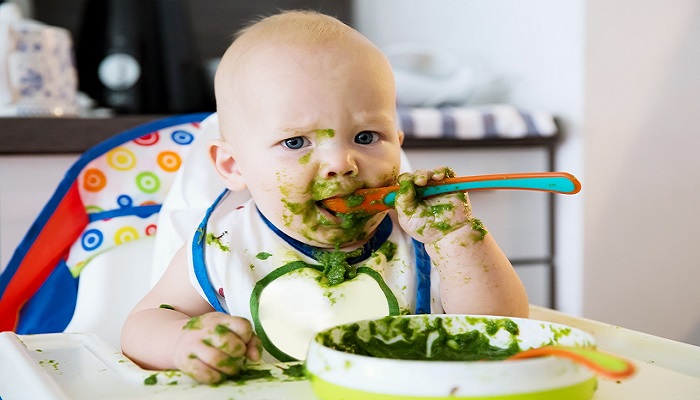
It is normal for babies to make a mess while they are getting used to new foods.

Find information on food to offer baby

Find first foods and recipe ideas here Eating well in the first year

Starting solid foods is a big step.

Many parents and carers have questions or worries.

This is normal, and confidence often grows as you and your baby learn together.

Keeping your baby safe

  • Always make sure your baby is safely strapped into their highchair.
  • Never leave your baby alone while they are eating or sitting in a highchair.
  • Watch your baby closely when they are eating so that you can spot signs of choking.
  • Check that food is not too hot before giving it to your baby.
    • If you heat food in a microwave, stir it well before serving to avoid hot spots.

Read up on choking and gagging on food

Find out what to look for and how to perform first aid

Foods to avoid

Some foods are not suitable for babies.

  • Avoid foods with added salt or sugar.
  • Babies under 1 can not have honey due to the risk of infant botulism, this includes products containing honey such as some cereals.
  • Foods that are a choking risk such as whole nuts.
  • Small round foods such as grapes and cherry tomatoes must be chopped in to quarters lengthways to reduce the risk of choking.

For a full list of food to avoid, visit the foods to avoid giving babies and young children webpage

Remember

Every baby is different. Some babies will enjoy lots of foods straight away, while others may need more time.

Be patient, keep offering a range of healthy foods, and try to make mealtimes relaxed and enjoyable.

Contact us

You can call our Single Point of Access (SPA) from Monday to Friday, 8:30am to 5pm.

  • Phone: 0113 843 5683

You can also keep up to date with our service and find more information on our Facebook or Instagram pages.

If you 11 to 19 you can contact us via ChatHealth.

Text a 0 to 19 specialist public health nurse on 07520 619 750

Relay UK: Free support to help deaf people and those who have hearing loss or have a speech impairment to communicate over the phone.

Contact us

You can call our Single Point of Access (SPA) from Monday to Friday, 8:30am to 5pm.

  • Phone: 0113 843 5683

You can also keep up to date with our service and find more information on our Facebook or Instagram pages.

If you 11 to 19 you can contact us via ChatHealth.

Text a 0 to 19 specialist public health nurse on 07520 619 750

Relay UK: Free support to help deaf people and those who have hearing loss or have a speech impairment to communicate over the phone.

survey icon

Tell us what you think

We would love to know what you think of our website and if there is anything we can improve.

Complete our survey and share your thoughts.

Leeds Community Healthcare NHS Trust Logo

Headquarters

Leeds Community Healthcare NHS Trust
White Rose Office Park, Building 3
Millshaw Park Lane
Leeds, LS11 0DL

Useful Links

  • News
  • Current vacancies
  • Contact us
  • Give feedback

Need to speak to someone urgently?

MindMate Website Logo MindWell Leeds Website Logo NHS 111 Logo
© 2026 Leeds Community Healthcare NHS Trust - Website by 6B
  • Accessibility statement
  • Privacy notice
  • Cookie policy
  • Terms and conditions
  • Policies and guidelines