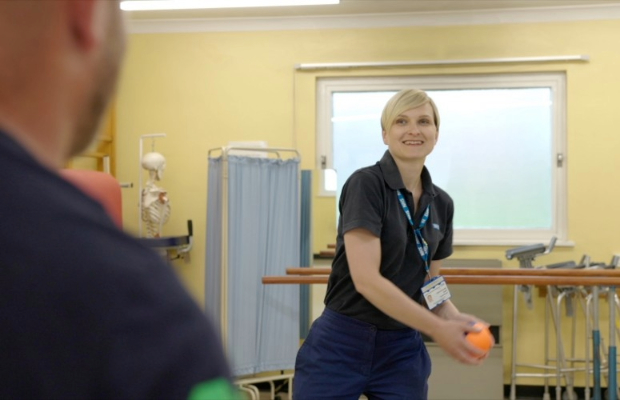
The Community Neurological Rehabilitation team are a specialist rehabilitation service provides therapy support to adults living with a neurological diagnosis and have a Leeds GP.
About the Community Neurological Rehabilitation team
The Community Neurological Rehabilitation team are a specialist rehabilitation service providing therapy to adults who live with a neurological diagnosis and have a Leeds GP.
We aim to empower people to develop, recover or maintain their meaningful activities, independence and quality of life.
Who we are and what we provide
We are a multidisciplinary team made up of a consultant in rehabilitation medicine, dietitians, nurses, occupational therapists, physiotherapists, psychologists and therapy assistants. For more information about what these professionals can offer, please see videos within each profession’s page.
The team offer goal focused rehabilitation for adults with neurological conditions within a defined period of therapy (which we call your ‘episode of care’). This may include advice, therapy and treatment for a patient, and advice and support for their family, carers and other professionals.
Therapy is offered in community settings, this can include at home, leisure or community facilities, a workplace, educational facilities or you might be offered an appointment in a healthcare setting.
We aim to support patients and their families or carers to be empowered to manage their health condition as best they can.
Referral criteria (inclusion and exclusion criteria)
Category
Inclusion criteria
Exclusion criteria
Has a neurological
Diagnosis on the accepted CNRT list.
Confirmed diagnosis listed on accepted CNRT list.
Central nervous system infections
Cerebral Palsy (If significant learning disability, then more appropriate to see the learning disabilities team, except for spasticity management clinic who will see jointly with learning disability therapists).
Developmental syndromes with CNRS anomalies as a major feature (excepting severe learning disability)
Functional neurological disorders
Multiple sclerosis and inflammatory disorders
Neuromuscular diseases
Parkinsonism and other extrapyramidal disorders
Choreiform disorders
Ataxias
Nutritional or toxic disorders of the nervous system.
Traumatic brain injury
Spinal cord injury
Spinal cord disorders excluding trauma
Acquired brain injury, for example, hypoxic
Tumours of the nervous system, stable, post‑treatment and wanting to engage in rehab
Neurovascular conditions: Stroke
Rare and other neurological diseases
Neuropathy: only if complex, multi‑domain rehabilitation needs (includes GBS)
Suspected, or probable neurological diagnosis only if actively being investigated by a neurologist. Note: FND must be confirmed diagnosis
Other:
Must have specific NEURO symptoms and where CNRT is the most appropriate service and no other service can meet their needs.
No neurological condition.
Excluded neurological conditions where it is the primary diagnosis reason for referral.
Epilepsy
Migraine
MND- separate pathway
Dementia and Alzheimer’s. Should not exclude if coexisting neurological condition and otherwise meets inclusion criteria
Nerve root or plexus disorders
Cranial nerve disorders
Radiculopathy
Neuropathy with non-complex single domain rehab needs not requiring specialist neuro rehabilitation (for example, diabetic neuropathy)
Service suitability
Aged 16+ (or 15 with transition pathway)
Registered with a Leeds GP and services can be delivered in Leeds (ICB 15F)
Medically stable to engage in rehab</li.
Able to engage in or be supported in goal‑oriented rehabilitation
Needs neuro specialist interventions, delivered in community setting, exceeding generic community therapy, and where we are the most appropriate service
Unstable medical condition (for example, uncontrolled seizures, acute infection).
High risk of harm to self, others and (or) mental health issues requiring specialist mental health services
Active substance misuse preventing engagement
Unsafe home environment preventing staff visits
Service delivery environment or location
Suitable for community‑based rehabilitation in Leeds.
Goals achievable in home or community or work or education environment
Goals achievable within current service offer
Requires intensive inpatient rehabilitation (for example, severe brain injury)
Requires early supported discharge or timely or acute intervention, send to NT. CNRT can accept for neuro rehab as well if indicated
Progressive terminal illness where palliative care is more appropriate
If primary need is:
Speech
Dysphagia
Housing
Equipment
Social needs
CHC – OT
Not acceptable CNRT, if primary need or goal is:
Speech or communication: Refer to speech and swallowing service
Dysphagia or swallowing: Refer to speech and swallowing service
Housing: refer to Engage Leeds or Leeds Housing options, Adult social care
Social care coordination or safeguarding: refer to Adult social care
Equipment and home adaptations. Refer to disability services OT for home adaptations and equipment
Complex capacity assessments requiring social work. Refer to adult social care. We might need to be involved to support in complex capacity assessments depending on what the decision is
CHC OT redirect to the neighbourhood team.
Information for patients
We accept referrals from GPs, consultants, or other healthcare professionals (please contact the service if you need a referral form). We also will accept self-referrals from patients who have accessed our service in the past.
Once a referral is received, a patient will be offered an initial assessment to determine if we are the right service to meet their needs. Once this is established, the assessment will focus on what the patient wants to achieve by working with our service (we call these ‘patient centred goals’).
The patient will then be placed on therapy waiting lists for the professionals they need to help them work towards their goals.
Our goal waiting times are up to four weeks for a priority referral and twelve weeks for a routine referral. Unfortunately, our waiting times are longer than we would like at present, but we are working hard to reduce these.
Patient engagement in rehabilitation is extremely important and we hope this video will help patients and their families to think about what goals they would like the service to support them to work on.
At the end of a patient’s episode of care, their therapists will provide them with advice about how they can continue to work on their goals.
Sometimes, it is felt that the patient will benefit from a short stay in a therapy bed when it is felt that the therapy needed can not be delivered at home or in community settings. This will be discussed between patients and their therapists and will be offered in a community bed.
If you have been invited to an appointment or group at St Mary’s Hospital, we expect that you will attend via your own transport, taxi, private car or bus.
If for any reason you are struggling to get to your appointment or group, please contact and discuss this with us.
Here is some useful contact information to support you with getting to your appointment or group.
Getting to St Mary’s Hospital
The following may help you:
Bus 16 or 16a wheelchair accessible: Seacroft to Pudsey. Every 10 minutes from Monday to Friday daytime. Stops directly outside the Hospital on Green Hill Road. Visit Wymetro website
Leeds alternative travel will take you door to door for a small charge 0113 386 8880
Contact Leeds Directory: for information about local travel schemes.
If you receive the high rate mobility component of the disability living allowance or PIP (PIP enhanced rate) or War pensioner mobility supplement you must use this to pay for your transport costs to appointment or group.
Travel costs
If you are on a low income you may be able to claim for a refund of your travel costs under the healthcare travel costs (HTC) scheme.
To find out if you are eligible and how to claim, visit the NHS Choices website or phone 0845 610 1112 to order a paper copy of the travel claim form and eligibility document (HC, HC11).
You can ring the Patient Experience team in Leeds.
Please keep receipts and records of your journeys.
Change in circumstances
If your situation changes and you are unable to attend your appointment or group, please contact the Community Neurological Rehabilitation service.
Parking
There is limited parking available (Including blue badge spaces) on the St Mary’s Hospital site for patients, staff and visitors. Parking is free.