


Accessibility and language tool guide
Skip to content
Leeds Community Healthcare NHS Trust Logo
Careers Contact Us
  • Home
  • Our services (A to Z)
  • About us
    • Access to information
    • Equality and diversity
    • Research
    • Awards
    • Infection prevention and control
    • Clinical and medical education and training
    • Board of directors
    • Working in partnership
    • Safeguarding children and adults
    • Charity
    • Sustainability
  • News
  • Join our team
    • Why work for us?
    • Flexible staff
    • Newly qualified graduates
    • Vacancies
    • Apprenticeships
    • Working and living in Leeds
  • Patient experience and engagement
    • Compliments, comments and complaints
    • Your feedback and experience
    • Person-centred care
    • Get involved
    • Thinking about using a camera or other equipment to monitor someone’s care?
    • Help to access and attend your appointment
    • About Me project
  • Contact us
    • Plan your journey
    • Location finder
    • Press and media enquiries
Skip to content
Leeds Community Healthcare NHS Trust Logo
  • Home
  • Our services (A to Z)
  • About us
    • Access to information
    • Equality and diversity
    • Research
    • Awards
    • Infection prevention and control
    • Clinical and medical education and training
    • Board of directors
    • Working in partnership
    • Safeguarding children and adults
    • Charity
    • Sustainability
  • News
  • Join our team
    • Why work for us?
    • Flexible staff
    • Newly qualified graduates
    • Vacancies
    • Apprenticeships
    • Working and living in Leeds
  • Patient experience and engagement
    • Compliments, comments and complaints
    • Your feedback and experience
    • Person-centred care
    • Get involved
    • Thinking about using a camera or other equipment to monitor someone’s care?
    • Help to access and attend your appointment
    • About Me project
  • Contact us
    • Plan your journey
    • Location finder
    • Press and media enquiries
Leeds Community Healthcare NHS Trust Logo
/Our services (A to Z)/0 to 19 public health integrated nursing service (0 to 19 PHINS)/What to expect at your child’s development review
Hero Banner Background

What to expect at your child's development review

Every child in Leeds is offered a developmental review between 9 to 12 months and again at 2 to 2.5 years of age.

At the review, we can:
Celebrate achievements: Notice all the new things your child can do.
Check progress: See how your child is talking, moving, playing and learning.
Offer advice: Share tips to help your child’s learning and health.
Answer questions: You can talk about anything you are unsure or worried about.

Dad and son playing

Why are development reviews important?

9 to 12 month review

Your baby is reaching exciting milestones! Around this age, they may start moving more, babbling, and improving their hand-eye coordination. This review helps us check their progress and spot any delays early, so we can offer the right support if needed.

2 to 2.5 year review

Toddlers grow and learn so quickly at this stage. Around age two, children often begin talking more, playing alongside others, and developing social and emotional skills. This review helps identify any concerns early, giving your child the best start before school.

What will we talk about?

Family in park

You may also want to talk about any of the topics below:

  • Behaviour, growth, sleep, and eating habits
  • Potty training, dental health, vaccinations, and safety
  • Screen time, keeping active, and school readiness
  • We’ll also check in on your wellbeing as a parent

Supporting information

toddler on dad's knee

Where possible, we encourage both parents to attend your child’s development reviews.

Your child’s development reviews will be carried out by a 0 to 19 family health worker or a specialist public health nurse.

We will contact you by text and by letter with an appointment which may be either a home visit or an invite to attend a local clinic setting or Children’s Centre.

We will also ask you to complete an ages and stages questionnaire (ASQ) about your child’s development before we see you at your appointment. It is important that you have completed this ASQ before your appointment. If you have any difficulty completing this, please call us on 0113 843 5683. We can arrange a longer appointment so a member of our team can help you on the day.

Or, if your child attends a nursery or childminder setting, then they may be able to help you complete the ASQ.

Why we use ASQ

ASQ helps you and our team understand how your child is growing and developing.
ASQ is not a test. There are no right or wrong answers.

Every child develops in their own way.

ASQ simply helps start a conversation about what your child enjoys, what they can do, and what support they may need.

Children grow and learn at different speeds. Small delays can be harder to notice.
ASQ helps us:

  • notice your child’s strengths
  • spot early signs that extra support may help
  • share simple ideas you can try at home
  • help you feel confident about your child’s next steps

Getting support early can help with learning, communication, confidence, and wellbeing.

What ASQ’s look at

ASQ‑3 looks at your child’s:

  • Communication skills
  • Gross motor skills
  • Fine motor skills
  • Problem‑solving skills
  • Personal‑social skills

ASQ:SE‑2: Social and emotional screening

ASQ:SE‑2 looks at how your child:

  • Self‑regulates
  • Follows routines
  • Communicates socially
  • Use everyday skills
  • Does tasks independently

For more information see areas of development below.

How ASQ’s work

  • You will get the questionnaire in the post with your appointment letter.
  • Depending on your child’s age, you may get one or both questionnaires.
    • 9 to 12 month development review: You will receive one questionnaire (ASQ-3) to be completed before your appointment. When you receive your ASQ try practicing the activities(or similar) at home.
    • 2 to 2.5 year development review: You will receive two questionnaires, an ASQ-3 and also an ASQ:SE which screens your child’s social and emotional development. Both these questionnaires will need to be completed before your appointment. When you receive your ASQ try practicing the activities (or similar) at home.
  • Please try to complete the questionnaire before your appointment.
  • When you receive it, have a go at some of the activities (or similar ones) at home.

If you are unsure about a question, or if your child has not tried an activity before, do not worry. Just answer as well as you can.

The questionnaire is matched to the milestones for your child’s age. If your child was born early (prematurely), we will adjust the age we use so the questions are right for them.

At your appointment, your 0–19 practitioner will go through the questionnaire with you. They can show you examples of activities if anything is unclear.

Remember: you know your child best. Your knowledge is important and helps guide the discussion.

What do ASQ results mean

After we look at the questionnaire together, we may discuss:

  1. your child’s development is on track

We will celebrate their milestones and continue with routine check‑ins.

  1. your child may benefit from more practice

We can share simple, fun activities you can try at home to help develop their skills.

  1. your child may need extra support

If the results show that more help could be useful, we will talk through next steps together.

This might include early years services, speech and language support, or other helpful resources.

ASQ does not diagnose any conditions.

It simply helps us decide whether more information or support may be helpful.

Measurements

During the review you will be offered for your child to be weighed and their height measured to make sure they are growing healthy.

At the 9 to 12 month development review your child can also have their head circumference measured.

Please remember to bring your child’s Red Book (Personal Child Health Record (PCHR)) so we can record this.

Communication

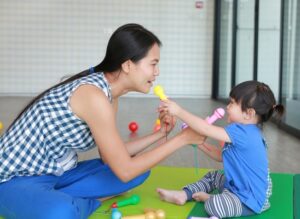
Mun and child_oriental

How your child listens, understands, and uses sounds, gestures, or words.

Examples:

  • Responding to their name
  • Pointing
  • Making sounds
  • Using single words or short sentences (depending on age).

Gross Motor

catching a ball

Big movements using larger muscles.

Examples:

  • sitting
  • crawling
  • standing
  • walking
  • running
  • climbing
  • kicking or throwing a ball.

Fine motor

Grandad and child drawing

Small movements using hands and fingers.

Examples:

  • Picking up small objects
  • Holding a spoon
  • Stacking blocks
  • Scribbling with a crayon, turning book pages.

Problem solving

Boy wearing headphones playing with toys

How your child learns, explores, and works things out.

Examples:

  • Fitting shapes into a sorter
  • Figuring out how to get a toy
  • Copying actions, following simple instructions.

Personal and social

How your child relates to others and manages their own feelings.

Examples:

  • Smiling at familiar people
  • Showing interest in other children
  • Playing alongside or with others
  • Showing independence (feeding themselves, trying to dress)
  • Beginning to share or take turns.

Contact us

You can call our Single Point of Access (SPA) from Monday to Friday, 8:30am to 5pm.

  • Phone: 0113 843 5683

You can also keep up to date with our service and find more information on our Facebook or Instagram pages.

If you 11 to 19 you can contact us via ChatHealth.

Text a 0 to 19 specialist public health nurse on 07520 619 750

Relay UK: Free support to help deaf people and those who have hearing loss or have a speech impairment to communicate over the phone.

  • Your Feedback means a lot: Complete our Friends and Family Test
  • How can we help you access and attend your appointment?
  • How to use ReciteMe accessibility and language tool guide
  • Support with accessing digital

Contact us

You can call our Single Point of Access (SPA) from Monday to Friday, 8:30am to 5pm.

  • Phone: 0113 843 5683

You can also keep up to date with our service and find more information on our Facebook or Instagram pages.

If you 11 to 19 you can contact us via ChatHealth.

Text a 0 to 19 specialist public health nurse on 07520 619 750

Relay UK: Free support to help deaf people and those who have hearing loss or have a speech impairment to communicate over the phone.

  • Your Feedback means a lot: Complete our Friends and Family Test
  • How can we help you access and attend your appointment?
  • How to use ReciteMe accessibility and language tool guide
  • Support with accessing digital
survey icon
Tell us what you think

We would love to know what you think of our website and if there is anything we can improve.

Complete our survey and share your thoughts.

Leeds Community Healthcare NHS Trust Logo
Headquarters
Leeds Community Healthcare NHS Trust
White Rose Office Park, Building 3
Millshaw Park Lane
Leeds, LS11 0DL
Useful Links
  • News
  • Current vacancies
  • Contact us
  • Give feedback
Need to speak to someone urgently?
MindMate Website Logo MindWell Leeds Website Logo NHS 111 Logo
© 2026 Leeds Community Healthcare NHS Trust - Website by 6B
  • Accessibility statement
  • Privacy notice
  • Cookie policy
  • Terms and conditions
  • Policies and guidelines