
Fatigue information and management
Fatigue as a symptom: a shared experience
- What is fatigue?
- What causes fatigue?
- Phone battery analogy
- Awareness
- Post Exertional Symptom
- Exacerbation (PESE)
- Recovering from PESE
Fatigue management
Practical advice for people who have fatigue due to a long-term condition.
- The 4Ps – Pace, prioritise, position and plan
- A.D.J.U.S.T
- Assertive communication
- Information on activities for fatigue management
- How to pace yourself
- Setting goals
- Fatigue diary
Fatigue as a symptom: a shared experience
Fatigue is a personal experience which can impact your physical, emotional, cognitive, social and functional health.
It is different from the typical tiredness that we all experience as fatigue may not improve with rest.
You may feel:
- Exhausted or ‘sleepy’
- Physically and/or mentally weak
- A lack of drive or motivation
- Feelings of irritability, frustration, or being overwhelmed.
Fatigue can be linked to chronic pain conditions such as Arthritis, Fibromyalgia, ME, sleep disorders, autonomic issues that lead to low blood pressure, or it may occur without any of these factors.
The words we use to describe our fatigue are often an indication of where it bothers us most. Such as:
- My bones feel heavy (physical fatigue).
- My brain is like mush (cognitive fatigue).
- I can’t be bothered to do anything (emotional fatigue).
- Spending time with people drains my energy (social fatigue).
- I can’t keep up with daily tasks (functional fatigue).
Look at the words you used to describe your fatigue, and you may see how fatigue is affecting you most.
This is a way to encourage understanding and make it easier to identify areas of life most affected by fatigue and find ways to address them.
It impacts on everything including everyday activities and can make even small chores or routine tasks seem impossible.
When living with a long term condition, fatigue is the most common symptom and can be hard to manage.
But it’s important to remember that you’re not alone.
Fatigue is the result of living within a reduced energy budget. Going over the energy budget can feel fulfilling but is often followed by Post Exertional Symptom Exacerbation (PESE).
PESE is when symptoms like fatigue get worse after doing physical or mental activities.
Fatigue impacts on every aspect of life from who you are, how you feel, what you do, how others may respond to you and your self-worth.
Fatigue can be:
- Distressing isolating and frustrating.
- Complex, multi-dimensional and multi-factorial.
- Experienced even with good quality sleep.
- Something that can be managed.
How you use your limited energy budget does have an impact on your recovery.
If you overexert yourself, you could experience a worsening of symptoms, like fatigue or brain fog. By managing energy carefully (through pacing and resting), you can avoid pushing beyond your limits, allowing your body to recover gradually and prevent setbacks.
On the diagram on the next page, circle the statements you agree with. Add any extra things you can think of.
What causes fatigue?
Internal causes/primary factors:
- Pre-existing medical conditions (such as pain, ME/CFS, or other chronic illnesses).
- Poor sleep quality (even if you sleep for long periods, the quality of sleep can be affected by your condition).
- Low mood or depression (often linked with chronic illness and can worsen fatigue).
- Personal values and self-expectations (e.g. the belief that you should push through fatigue or avoid being seen as ‘lazy’).
- Stress (both physical and emotional stress can increase fatigue levels).
- Past trauma (which can contribute to heightened sensitivity to pain and fatigue).
- Immune system dysfunction (which can be a factor in conditions like ME/CFS).
- Increased inflammation (common in conditions like fibromyalgia, arthritis, and ME/CFS).
External causes/secondary factors:
- Lack of understanding or awareness (how chronic illness affects fatigue).
- Diet and nutrition (poor diet or imbalances can affect energy levels and overall health).
- Deconditioning (muscle weakness or physical decline due to inactivity, often a result of pain or fatigue, discussed later in the booklet).
- Stopping activities, you enjoy or reducing social interaction (this can lead to emotional fatigue and a sense of isolation, which can make fatigue worse).
- Medication side effects (some medications for pain or other symptoms can increase fatigue).
- Pressures and expectations (from work, family, friends, or yourself, which can cause stress and worsen fatigue).
- Societal values or stigma (misunderstanding about invisible illnesses like ME/CFS or fibromyalgia, and how it impacts daily life).
- Financial pressures (concerns about money, debts, housing, etc. can cause ongoing stress that worsens fatigue).
- Environmental factors (such as living in an environment that isn’t supportive of rest or recovery, like noise, overcrowding, or lack of a comfortable space.
Our energy levels can be seen as a battery pack of power.
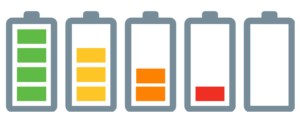
How much energy do you have in your battery pack right now?
How much energy are you generally able to get in your battery pack?
Everything we do takes up energy. Each task we do takes some charge from that battery. Ideally, we should have enough battery power to allow us to complete all our activities before running out at the end of the day.
Every activity, no matter how small, requires energy. Think of your energy as a battery – each task you do drains a little from it. Ideally, you want enough energy throughout the day to complete all your activities without running out before you’ve finished. However, with chronic fatigue, the ‘battery’ may drain more quickly, making it harder to accomplish everything you’d like to do.
Knowing how your body responds to fatigue is called awareness – the feeling of knowing what is happening in your body.
Awareness of the sensation of fatigue is crucial for understanding your battery charge.
A fatigue diary may help you understand your energy patterns.
Therefore, adjusting your expectation from what you think you should be doing to what your energy budget may allow you to do, is the most important starting point to managing fatigue.
For some people, they may have heightened or over awareness of sensations in the body. For others, awareness of sensations maybe dulled. Both these states of under and over awareness of body sensations makes managing fatigue a challenge.
When we have fatigue, we are unable to fully recharge the battery, leaving us at risk of running out of energy before we have done all we expect of ourselves.
Our minds may expect the same level of activity as before the onset of chronic illness, but our ‘batteries’ may struggle to fully recharge, leaving us unable to meet those expectations.
Working on empty can cause an exacerbation of symptoms such as muscle and join pain.
Lots of people who experience fatigue find themselves in what we call the Boom Bust Cycle. This is when we do too much on a good day(s) and then have a ‘crash’ period afterwards. People often describe trying to fit everything in while they feel like they have some charge in their battery. It is tempting to do as much as possible while the energy is there and push past our limits – this ‘flattens the battery’ even more. When the battery has been flattened, there is no choice but to stop and actively rest to ‘recharge’.
Recovering from Post Exertional Symptom Exacerbation (PESE)
Going over your energy budget causes your symptoms to increase.
To avoid PESE, we must work to the optimum of our energy pack and not stretch too far ahead or beneath it. We must remember that our use of energy impacts on our recovery.
PESE can manifest up to 72 hours after doing too much. Once you have stabilised your energy budget, you can work to a slow incremental increase of between 5%-10%.
If this is successful without signs of unmanageable fatigue, increase the amount again three times in a slow, stepwise way.
Research has shown that by slowly and incrementally increasing activity, our battery is able to charge more fully. It is therefore more effective on our physical and psychological wellbeing to pace, prioritise and plan activities.
Fatigue management
An easy way to remember fatigue management:
Pace
Pacing involves changing your thinking around completing tasks. To pace yourself, you may do a task more slowly or break it up with rests to prevent making your fatigue worse.
You may also ask others for help in completing certain tasks. It includes spreading out the activities that you do more evenly over days.
Pacing can help you do more in your life. Pacing can be hard to start with but can help increase your activity levels in the long run. If your battery is completely flat, it can take a long time to
recharge. Try and stop before your battery runs flat by pacing – pausing to recharge/rest to add some charge throughout the day. Distribute your energy evenly throughout the day to prevent the need to fully recharge the battery.
Take your foot off the gas – doing things more slowly (and pausing to rest) is evidenced as a more efficient way of using energy. Much like a car will go longer and further at 30mph rather than 70mph.
Below is an example of pacing when climbing the stairs. Instead of climbing all the stairs at once, break this down with rest.
- Climbing all the stairs at once
Outcome: You must rest for 10 minutes at the top and feel tired the following day
- Climb 3 stairs, rest for 30 seconds
Climb 3 stairs, rest for 30 seconds
Climb 3 stairs, rest for 30 seconds
Outcome: You don’t need a long rest at the top and don’t feel so tired the following day
Prioritise
This involves identifying the most important tasks and activities and focusing your energy on those, while delegating or postponing less crucial tasks. Doing things we enjoy puts energy in the budget. The right amount of exercise, sleep, fun, nutrition, time in nature and relaxation are all important things to put energy back – to recharge.
Often when we are fatigued, things that we would normally deal with become overwhelming. We sometimes feel unable to cope. This sets off a negative cycle – the more overwhelmed you feel, the more fatigued you feel.
Essential tasks first: Focus on what must be done (e.g., meals, hygiene) and leave less urgent tasks for later.
Ditch or delegate: Let others help with non-essential tasks or postpone them.
Say no when necessary: Protect your energy by avoiding overcommitment.
Position
Think about your body position while completing tasks throughout the day. Bending and reaching can cause fatigue and shortness of breath. Try keeping objects in easy to reach places.
Consider doing important tasks on a perching stool rather than in standing, e.g. washing up to conserve energy to allow you to complete other tasks throughout the day.
Consider sitting to shower rather than standing if it makes you breathless.
Remember to change your position regularly to prevent stiffness and promote mobility.
Plan
Plan what you are going to do ahead to maximise your energy levels. For example, before showering, make sure your towel, clothes and necessary daily items are in the bathroom area.
Create a structured schedule: Plan each day with clear activity and rest periods. Use timers to limit activity.
Include rest: Plan for regular breaks and downtime, especially after more demanding tasks.
Use a weekly plan: Spread tasks throughout the week, keeping in mind your energy limitations.
TIP: Use a fatigue diary.
Fatigue diaries can help you understand your energy expenditure and the impact on your body. They can also help you plan activities within your current energy budget.
We understand that fatigue diaries take energy to complete. However, if you feel you are being controlled by fatigue rather than feeling that you understand your energy patterns, these diaries can help you to get a better understanding of your fatigue.
When completing the fatigue diaries, we ask you to write what you have been doing throughout the day then score your fatigue on a scale of 0-10.
Analyse your fatigue diary
Study your fatigue diary and consider how much you want to do in the day. Ask yourself the following questions. You can discuss this with your family, friends or therapist:
- How much energy do you have?
- What do you want/need to do?
- In what order?
- Can you alter any patterns in your fatigue diary?
- Are there any activities that make you feel especially fatigued?
- Are there particular times in the day you are most fatigued?
- Are you taking enough breaks? Are you taking them at the best time?
- Are you getting up and going to bed at the same time each day?
- Are you able to do activities that you enjoy?
- Are there any activities that you could delegate to others?
- Are there any activities that ‘top up’ your energy levels?
- Are you ‘topping up’ your energy levels throughout the day?
- What number should you let your fatigue reach before you rest?
- What are the barriers to change?
Plan for rest as well as activity. Examples of restorative rest include soft, slow, low breathing, relaxation, being in nature, self-care, gentle exercise/stretching, good nutrition, whatever brings you joy.
A – Adjust
Adjust your expectations of yourself and what you can do now.
Remembering how things used to be; wishing and waiting for the fatigue to lift or alternatively pushing through irrespective of your energy budget, can contribute to the negative impact of fatigue.
D – Delegate
Ditch and delegate the things that aren’t meaningful or pleasurable, leaving energy to engage in valued activities.
J – Judge
What is in my energy budget? How can I neither over nor under exert myself?
U – Understand
That fatigue is real. Even if you or others can’t see it – The Spoon Theory on page 20 may help.
S – Savour
Savour the time you can spend doing the things you enjoy and make time to do them within your energy budget.
T – Talk
We often don’t like being the one who is always complaining about how hard things are. Being able to speak to a professional or trusted friend will help give a different perspective. It can be hard to see the wood for the trees when we are fatigued. Others may be able to spot ways that we can conserve and/or budget our energy more effectively. As well as being helpful, this can also help us feel less isolated and better understood.
Being assertive involves explaining your wants and needs in a way that is not rude to others but means they will understand how best to support you.
As fatigue is an unseen symptom, it can often fall on the person with fatigue to have to explain this to others. This includes being assertive about your needs. For example, a friend may wish to invite you for coffee, but that day you already have an appointment meaning you do not have the energy in your battery to do both. Saying no can feel uncomfortable and rude, so think how you can explain this in a positive way.
For example, say: ‘I would love to come for coffee tomorrow, however, my fatigue means that I will struggle to enjoy this fully as I already have an appointment that day. Would it be possible for later in the week?’
This can be difficult as you may need to repeat things like this regularly to friends and family, but remember, they do not know how best to support you unless you tell them!
Prioritisation activity
This activity will help you prioritise. Use different coloured highlighters or pens.
List ALL the activities you do in a typical week (or day).
Now work through your list highlighting in different colours:
- Which activities are very important.
- Which activities you would rather not do.
- Which activities could be done less often.
- Which activities do not need to be done at all.
Also ask yourself:
- Could any activities be done in a more energy efficient way?
- Could they be done at a different time?
- Could they be done less often, or for less amount of time?
- Can anyone or anything help you with these activities?
Plan
Consider how much you want to do in the day, how much energy you have and what you want/need to do and in what order. Plan for rest as well as activity. You can also use planning to spread your activities across the week. For example, if you have an appointment on Monday, then arrange to see your friend on a different day.
Consider using a timetable. This could be on paper, a white board or your mobile phone to help see how your activities are spread across the day/week.
Work out your baseline (what can you manage without increasing negative symptoms, at least most of the time). E.g. if you know that 20 mins on the phone with a friend may tire you then your baseline may be more around 10 – 15 minutes.
The traffic light system: This can be a strategy used to help you identify which activities are very demanding on your fatigue levels and which activities may be less demanding. Thinking about activities in this way can help you to plan your day.
Remember to consider the cognitive, emotional and social demands of activities, as well as the physical demands.
RED: Demanding activities
AMBER: Moderate activities
GREEN: Light / relaxing activities
Try to create a weekly schedule with some activities you need to complete in your day. Then colour code the activities specified in the traffic light system.
It is important to take regular rest breaks and use green activities to break up any consecutive periods of red activities.
Similarly, try and insert some amber and red activities into long stretches of green.
Make sure to prioritise – ask yourself, does this activity need to be done? Or could I delegate it to someone else?
Pacing: Once your routine is stabilised, try to build on your activities to slowly increase activity levels.
Monitor your fatigue and adapt accordingly, allowing your body time to respond to activity level increase.
Take your time with this and make sure the process is slow and steady.
How to conserve your energy
You may need to make small changes to your activities to help you maximise your energy levels throughout the day.
Here are some examples of an activity which can be modified to help conserve energy:
Getting ready:
- Sit when you need to.
- Support your elbows when a task takes longer than five minutes.
- Avoid aerosols and strong scents.
- Consider easy to manage hairstyles.
Dressing:
- Sit down when you need to.
- Complete lower body dressing first.
- Cross your legs or raise on a step stool to reduce bending.
- Choose front opening, loose-fitting clothes and safe slip-on shoes.
- Gather your clothes together before dressing.
Bathing/showering:
- Sit as much as possible when undressing/bathing/drying.
- Make sure that you use stools/chairs that are designed to be used in bath/shower.
- Contact your occupational therapist or visit William Merritt for advice on suitable aids, equipment and adaptations.
- Use long-handled aids for your back and lower body.
- Use a towelling dressing gown instead of drying with a towel.
Cooking:
- Sit down when peeling and cutting vegetables. Consider buying prepared vegetables or prepare in advance.
- Plan for leftovers (freeze any leftovers which can be reheated later).
- Implement regular resting breaks throughout the cooking process. Make sure you rest before and after you start cooking.
- Push or slide heavy kitchen items across the kitchen surface instead of lifting them.
- Use smaller pans if possible so they are easier to lift.
- Only fill the kettle with as much water as you need and hold with both hands.
- Consider using an aid (such as a kitchen trolley or caddy if safe to do so) to reduce carrying and frequent trips.
- Consider having a bottle of water with you in easy reach to remain hydrated.
Housework:
- Spread tasks out throughout the week, i.e. hoover one room a day. Consider bringing laundry downstairs each day to avoid carrying large loads.
- Sit down to complete the ironing and iron only what is necessary.
- Could someone else do the more heavy-duty housework tasks?
- Use long handled equipment where you can, i.e. use a mop to clean spillages instead of bending down to the floor and using kitchen towels.
- Allow dishes to air dry instead of drying them with a tea towel or use kitchen foil where possible to reduce the amount of washing up.
- Bend properly by bending your knees, do not hunch over.
Out and about – plan ahead:
- Try not to do too much in one day and know where you can rest.
- Use a trolley rather than a basket when shopping as you can rest on it. Shallow trolleys distribute weight more evenly making it easier to push, and you do not have to bend to reach items.
- Use mobility aids if needed. Consider hiring a wheelchair when out and about.
- Choose routes with minimal traffic and avoid peak hours to conserve energy.
- Break long journeys into shorter, manageable segments.
- Incorporate regular breaks into your itinerary to recharge.
- If possible, ask a partner or friend to drive.
- Find suitable parking for where you are going (close to destination). Consider applying for a disabled parking permit (blue badge) to access designated spaces.
- Use a reliable navigation system to reduce stress and ensure you stay on the correct route.
Work:
- Optimise work schedules with flexible breaks.
- Shorter shifts with regular breaks.
- Job sharing to distribute workload.
- Promote open communication about fatigue concerns within workplaces.
Think of an activity that you do frequently. Are there any ways you could break down the activity to help manage your fatigue?
Other ways of managing fatigue is to try to improve your sleep and focus on relaxation techniques.
Hopefully now you understand your fatigue a little better. We will now explore different ways you can help manage your fatigue.
Setting goals
Some people find it useful to set goals to help them implement fatigue management strategies.
Setting goals allows us to make positive changes to our lifestyle and provides us with something to work towards.
Here is an example of a goal you could implement:
I am going to start doing 10 minutes of breathing exercises daily. I will be doing it daily in two weeks’ time.
Spoon theory
The spoon theory is a creative way to explain to friends and family what it’s like living with chronic illness. Often people can have limited energy, represented by spoons. Doing too much in one day can leave you short on spoons the next day.
If you only had 12 spoons per day, how would you use them?
Take away one spoon if you didn’t sleep well last night, forgot to take your meds, or skipped a meal. Take away four spoons if you have a cold.
Don’t forget that if something brings you joy, or you have managed to recharge, it is possible to create spoons.
Ref: The Spoon Theory was written by Christine Miserando
www.butyoudontlooksick.com
Recording your fatigue level after activity and rests
Instructions
- Start at the beginning of each day (6 – 8am).
- Write down each activity (and any rests you have taken) into each two hour box.
- Using the scoring scale above, score how you felt at the end of that two hour period.
- Please record any other factors you feel are relevant e.g. stressful events, over exertion, skipping meals.
Your completed boxes should look something like this:
| 8 – 10am | Washed and dressed
Breakfast Read paper |
5 |
| 10 – 12pm | Drive to supermarket
Shopping Drive Home |
8 |