
Check your breathing
Check your breathing
| When sitting, do you breathe through your | Nose | Mouth | ||
| Can you hear your breathing? | Yes | No | ||
| How many breaths do you take in 1 minute? | 8 to 12 | 13 to 16 | 17+ | |
| Does your stomach expand as you breathe in? | Yes | No | ||
| Does your upper chest rise as you breathe in? | Yes | No | ||
| Time how long you can hold your breath for | Under 30 seconds | Over 30 seconds | ||
| Do you sigh or yawn a lot? | Yes | No | ||
Transcript
Before we get into the main presentation today, have a couple of minutes to think about your breathing right now. Use the table on the screen now to help you with things to look out for- particularly whether you breathe through your nose or your mouth, whether you can hear your breathing, and whether your tummy and/or chest is moving. Try not to think about this too much or change your breathing, just notice what your body is doing. There is no wrong way to breathe- you are all breathing right now- but later in this session we will look at the ideal way of breathing at rest, and you can see how this compares to what you are doing now. Continue this for the next minute or so
Causes of breathlessness
Causes of breathlessness
Transcript
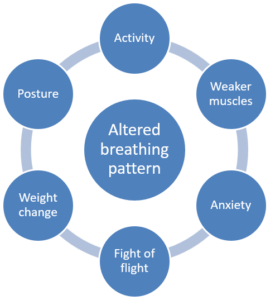
The diagram above shows different causes altered breathing pattern, including:
- Activity
- Weaker muscles
- Anxiety
- Fight of flight
- Weight change
- Posture
So why do we get breathless? Being breathless is normal for everyone- if we were to go and run around or do some other activity outside we would all get breathless from doing so. You may find that doing certain things now makes you more breathless than usual- if you have been unwell for a while and less able to do your usual activities you may have become deconditioned where your muscles are a bit weaker from not being as active, this in turn will mean that moving is more effortful and therefore make you more breathless. Feelings such as anxiety, stress, worry etc. can cause your body to go into the “fight or flight” response, where your body is getting ready to respond to a situation and therefore starts to breathe harder and shallower, leading to feelings of breathlessness. Being underweight or losing weight may mean your breathing muscles have become smaller and weaker, therefore taking more effort to get air in and out of your body. Being overweight or gaining weight can make activities more strenuous, and also put more pressure around your chest and diaphragm which can restrict how much your lungs can expand. Having a poor posture where shoulders are elevated or rounded, our upper body is in more of a hunched position or our head is more forward, can all make our breathing more effortful and therefore lead to breathlessness quicker. With all of these factors, the main thing to note is that they can lead to our body changing the way we breathe away from the ideal method, thus leading to an altered breathing pattern.
Breathlessness Cycle
Breathlessness Cycle
Transcript
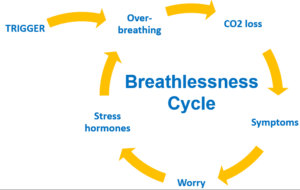
This diagram shows the cycle of breathlessness and inactivity, and highlights how the changes previously mentioned can lead to increased breathlessness over time. Our trigger may be something physical such as being unwell with a cold or having a flare up of our symptoms, but it could also be from the stresses of having a long term health condition and the extra challenges faced everyday because of this. This stress may be linked to financial worry, difficulty with work or daily activities, or worry about not being able to do certain things in a timely manner. This can unconsciously change how we breathe so we start to over-breathe, working harder than we need to. This can then feed into our symptoms and cause further symptoms that feel unpleasant. These symptoms can be worrying and therefore release further stress hormones which then completes the cycle and causes further breathlessness. The good news is that with patience and practice, this vicious cycle can be broken and we can reduce our breathlessness.
Good breathing pattern
Good breathing pattern
- Nose
- Diaphragm
- Passive exhalation
- Quiet
- RR = 8-12 at rest
- I:E = 1:2
- Regular, Rhythmical, Relaxed
Transcript
So, what does an ideal breathing pattern look like? At rest, it is important to breathe in and out using your nose only, as this helps to filter the air you breathe in to reduce your risk of becoming unwell, and humidifies the air so it prevents your airway from becoming dry. Our most efficient breathing muscle is our diaphragm, which is an umbrella shaped muscle that sits between the bottom of your lungs and your stomach. When we breathe in using our diaphragm it flattens and pushes out in all direction, so you should be able to feel your stomach rising as you breathe in. As we breathe out the diaphragm relaxes and returns to its normal position, and this should be a passive process as we are relaxing and letting the air go rather than forcing it out. Our breathing at rest should be quiet, and you should aim to complete 8-12 breaths per minute in a steady rate. Our breath out should be longer than our breath in, and there should be a slight pause after breathing out before taking our next breath in as our body resets and prepares for the next breath. There are a lot of components for something as simple as breathing which we have all done since birth without thinking, however with time and practice you will be able to get this breathing pattern to be regular, rhythmical and relaxed.
Comparing breathing patterns
Comparing breathing patterns
“Normal” Diaphragmatic Breathing. Uses only 3% daily energy.
”Dysfunctional” Apical Breathing. Uses up to 30% daily energy.
Transcript
This animation shows the difference between using our diaphragm and our chest/apical muscles to breathe. As you can see, using our diaphragm gets air right to the bottom of our lungs so we are able to better meet the body’s demand for air, whereas using only our chest means the air only gets into the top part of our lungs. To make up for this our breathing tends to speed up, and we end up going into the over-breathing we mentioned earlier. Using our diaphragm only requires around 3% of our daily energy usage, whereas using our chest can take up to 30%. This is important when trying to manage energy budgets for people with fatigue, as saving this energy will help to reduce our fatigue or have energy available for other activities that we want to do.
Breathing Control
Breathing Control
Breathing Control
- Breathing gently with minimal effort
- In and out through our nose
- Uses diaphragm, not chest
- Easiest to practice lying down
Rectangular Breathing
- In for 1 count
- Out for 2 count
- Slight pause
- Symptoms during are normal
Transcript
The best ways to practice and improve our breathing pattern is by using breathing control to get used to our nose and diaphragm doing all the work, and rectangular breathing to help with the timing of our breaths. For breathing control, it is generally easier to practice this whilst lying down on our backs or side. This is because our diaphragm also works on keeping our upright posture against gravity, but by lying down it can relax from working on posture and focus more on breathing. It is also easier to feel our stomach moving forwards, as the diaphragm can not move backwards against the bed/floor. You may initially need to take bigger breaths to feel your stomach moving, and by doing this your chest will move a little bit to accommodate the extra air coming in. This is okay to begin with, but as you get better with engaging your diaphragm you should aim to get a similar movement without taking as big of a breath. For rectangular breathing, you should aim to take a breath in for a count of 1, and out for a count of 2. Some people to prefer to use a visual aid of anything rectangular such as a TV, mirror, screen etc, and breathe in whilst tracing your eyes along the short edge, and breathe out as your eyes go along the longer edge. As mentioned before there should be a slight pause after breathing out, so it should go 1, 2., pause. It is important to note that you may experience some light headedness or dizziness whilst doing this, this is a normal response to you breathing in a way your body is unfamiliar with. If this happens to you, do the good breathing practice for as long as you can tolerate, and then stop and do something else when you feel able to safely get up and move. Over time this will reduce as your body begins to tolerate this ideal breathing pattern.
Practical pause- good breathing
Practical pause- good breathing
Checklist:
- Use your nose
- Relaxed and quiet
- Use stomach and diaphragm
- Keep your chest relaxed
- Follow the rectangle
Transcript
Now we have discussed how to go good breathing, we will have a pause in the presentation for you to try and practice what we have discussed so far. Take some time to get into a comfortable position (sitting is okay) and practice breathing through your nose and using your diaphragm, and if able work on the rectangular breathing as well. After this pause we will look at ways of managing breathlessness during activity. If you are watching this recording as a video, please pause now for a few minutes.
Controlling breathing during activity
Controlling breathing during activity
Paced breathing – Timing breathing to activity
Pursed lip breathing – “O” shape mouth to exhale
Blow as you go – Breathing out on the effort
Transcript
Being breathless during activity is normal, and our chest muscles will start to work to keep up with the increased demand for air. However there are certain techniques we can use to prevent getting as breathless as quickly. Paced breathing is where we time and time our breathing to our activity, for example when climbing stairs breathing in for 2 steps and out for 3 steps. Pursed lip breathing means breathing out though your mouth, but making an O shape and releasing the air slowly. If there was a candle in front of you then you would want to move the flame but not blow it out. Blow as you go means breathing out on the effort of a task, such as lifting, reaching, bending. By practicing these techniques for your daily activities, over time you should notice you are able to do a little more than you could before, or you can do the same amount without being as short of breath.
Positions of ease
Positions of ease
As well as the techniques we discussed, there are also certain positions that can help us to recover from breathlessness quicker so we can return to our activities sooner. If you are able to sit down, leaning forwards resting your forearms on your lap can help to relax your shoulders and chest muscles to help taking good quality breaths with your diaphragm. If you are able to sit at a table, leaning forwards with a pillow for your head can also work in a similar way. If you are unable to sit down, for example whilst out shopping, you can lean forwards slightly against a trolley or a low wall, or against the back of a chair. Alternatively, you can lean with your back or a shoulder against a wall, allowing your legs and body to relax and help with resting and recovering quicker.
Talking
Talking
- Let people know you’re struggling
- Adopt a good posture when talking – sitting upright rather than slumped
- Be patient with yourself
- Use shorter sentences
- Find natural pauses in and at the end of sentences
- Take appropriately frequent breaks when talking
- Practice conversation pacing and use a quieter voice
- Try singing
Transcript
Now we have discussed how to go good breathing, we will have a pause in the presentation for you to try and practice what we have discussed so far. Take some time to get into a comfortable position (sitting is okay) and practice breathing through your nose and using your diaphragm, and if able work on the rectangular breathing as well. After this pause we will look at ways of managing breathlessness during activity. If you are watching this recording as a video, please pause now for a few minutes.
Helpful tips
Helpful tips
- Plan your day in advance and pace yourself
- Break down your activities into smaller tasks that are more manageable
- Use a towelling robe after showering or bathing, as you’ll use less energy than drying off with a towel
- Put items that you use frequently in easy-to-reach places
- Wear clothes and shoes that are easy to put on and take off
- Don’t be afraid to ask for support from people around you when you need it
- Be patient with yourself and give yourself time to do things
Transcript
Now we have discussed how to go good breathing, we will have a pause in the presentation for you to try and practice what we have discussed so far. Take some time to get into a comfortable position (sitting is okay) and practice breathing through your nose and using your diaphragm, and if able work on the rectangular breathing as well. After this pause we will look at ways of managing breathlessness during activity. If you are watching this recording as a video, please pause now for a few minutes.
Resources
Resources
Websites
- Asthma and Lung UK
- Physiotherapy for BPD
- Shared Harmonies- Singing for Lung Health/Relax Breathe Harmonise- www.sharedharmonies.co.uk
Apps/Youtube/Podcasts
- Headspace
- Calm
- Unmind
- Breathing mantra
- Breathing Tree by Rebecca Dennis- Episode 197