Your child's hearing test
Community audiology is a team of professionals who specialise in testing children’s hearing.
This page tells you about some of the hearing tests we use. We hope this will help you talk to your child about what.
Audiology tests
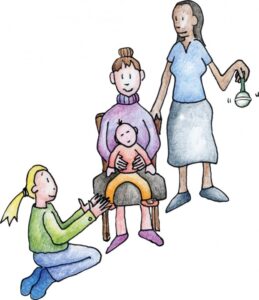
- If your baby can sit unsupported, distraction testing can be used.
- Your baby will sit on your knee with you holding them around the waist.
- One tester will keep your baby’s attention by playing with some toys.
- The other tester will make a range of different sounds from behind your baby.
- We want to see if your baby will turn to look when they hear the sound.
- The sounds will be low, middle and high pitched.
- The sounds will start off quiet and get louder.
- We want to find the quietest sound at each pitch that your baby will turn for.
- It is very important that you don’t give any clues when the sound is there.

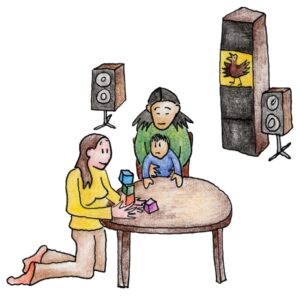
- Visual reinforcement audiometry can be used to test babies who can sit unsupported, and toddlers.
- Your child will sit on your knee with you holding them around the waist.
- On each side of the room are two speakers, with cabinets with toys that light up inside.
- One tester will keep your child’s attention by allowing them to play with some toys on the table.
- The other tester will work the test equipment.
- Your child will be shown that when a sound comes, a toy lights up.
- This will encourage your child to turn around each time they hear the sound.
- We want to find the quietest sound at each pitch that your child will turn for.
- It is very important that you don’t give any clues when the sound is there.

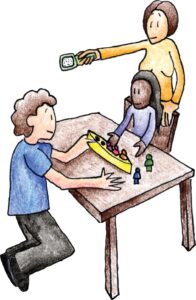
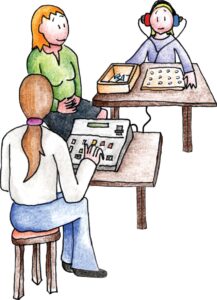
- Older toddlers and pre school children may be able to do a performance test.
- One tester will stand behind your child with an electronic “Warbler” which makes sounds of known pitch and volume.
- The other tester will show your child the “game”: when they hear the sound they put a man in the boat.
- When your child plays the game they will be tested with low, medium and high pitched sounds. The sounds will start off loud and get quieter.
- The gaps between the sounds are changed to make sure they are not guessing.
- We want to find the quietest sound that your child can hear at each pitch.

- Pure tone audiometry is used with older pre school children and school age children.
- The child listens for different tones through headphones.
- Each time they hear a tone they put a peg in a pegboard: older children and teenagers are given a button to press.
- The tones start off loud and get quieter until they are no longer heard.
- Pure tone audiometry tells us the quietest sound that can be heard in each ear, at each pitch tested.

- The toy test is used with older toddlers and pre-school children.
- The tester puts some toys out on the table in front of your child.
- The toys are in pairs and are chosen because they sound similar, for example, key and tree.
- Your child will be asked to point to a toy.
- The tester will make sure your child can’t lip-read.
- The tester’s voice level is measured.
- This test is used to see how well your child can hear speech.
Performance audiometry is a hearing test than can be used to assess children’s hearing. Children will be shown how to perform a repetitive play task such as putting a toy man in a boat each time they hear a sound. The sounds can be presented through a speaker or headphones.
How to prepare your child at home
Try playing a listening game using the following instructions. It is helpful to complete a few demonstrations at the beginning of the game where you help your child complete the task when you make the sound. Try to speak at a level that you think your child can easily hear.
- Cover your mouth and say “beep, beep”, or “ready, steady, GO” and have your child do something every time they hear it (for example, toss a block into a bucket, buttons in a tin, build a tower with bricks).
- Next vary the amount of time between each instruction so your child learns how to wait and try not to prompt your child by giving any non-verbal clues.
- Praise your child each time they perform the task correctly and waited for the sound.
- If your child goes before the sound, remove the object out of the box/tower and gently remind them to wait for the sound. You can also complete a few more demonstrations if needed.
Note: Remember, your child must learn to wait until you have said “GO” or “BEEP BEEP” before performing the task.
By practicing the above game with your child at home we hope children will attend clinic with a better understanding and a feeling of confidence during their hearing assessment.
Preparing your child for their hearing test
Children often don’t like to wear headphones or have their ears touched, which can make it difficult to complete a full hearing assessment. We always try to make the appointment as fun and relaxed as possible for the child and you can help us by preparing your child before their appointment.
A few ideas to try to prepare your child for their appointment:
- Try using headphones or earphones at home. Wear them yourself and encourage your child to try them whilst listening to their favourite music or watching their favourite TV show, so that it becomes fun.
- Touch your child’s ears occasionally during the course of the day.
- If you have a toy doctors kit you can pretend to look in each other’s ears or in the ears of their teddy or doll.
- Watch videos on the internet of children having their hearing and ears checked
If your child is developmentally around the 2 to 3 years level it may be useful to practice a ready, steady, go type game at home. This will help to improve your child’s waiting skills and confidence for a listening game which we may use in their appointment.
You can practice this in different ways:
- 1,2,3 jump
- Stop, wait and roll the ball
- Ready, steady and dance