

How to care for and prevent injury from your catheter
What are meatal tears?
What are meatal tears?
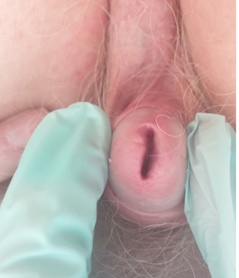
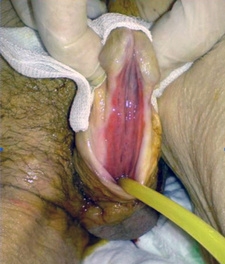
Injury (including tearing, pressure damage, sore skin) of the urethra, particularly the urinary meatus, occurs in individuals who have had indwelling catheters for a long period of time.
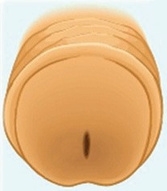
The urinary meatus (pronounced me-ate-us) is the slit like opening at the end of the penis. This is the end of your urethra (the tube that carries urine from the bladder to the outside) where it reaches the tip of your penis. When you have a urinary catheter there is an increased risk of injury to the meatus. Injury, especially tears to the meatus, can occur for several reasons, most commonly including:
- Incorrect securing of the catheter tubing which results in tension.
- Incorrect securing of the urine collection bag which results in tension.
- Pressure from the catheter tubing.
The meatus is a very sensitive part of your body and therefore if things are not right you may feel discomfort or pain.
If you have reduced sensation below your waist, a neurological condition or diabetes you should take special care as you may not experience early warning signs of discomfort or pain.
Example of a normal meatus:
Examples of meatal tears:
Top tips for looking after your catheter
Top tips for looking after your catheter
Good catheter care can help reduce the risk of an injury or tear to your urinary meatus. Follow these top tips for looking after your catheter to reduce this risk.
- Always wash your hands before and after every contact with your catheter or penis.
- Keep your penis clean and observe the skin around your meatus regularly.
- Use a cotton wipe (these are usually supplied when your catheter equipment is delivered) or a clean flannel with a mild soap and warm water to clean the end of your penis and around the catheter tubing as detailed below.
- Clean the end of your penis and under your foreskin at least once daily and, whenever possible, after every bowel movement. Always return the foreskin to its natural position.
- Use a new the cloth to gently remove any debris or mucus that has accumulated around your catheter where it meets your meatus.
- Clean down the length of the tubing towards your urine collection bag. Try not to pull or add tension to your catheter tubing at any time during cleaning.
- Every day, when cleaning your penis, observe your meatus checking for any redness, soreness, tears or injury.
- Report any discomfort or sores to your nurse as soon as possible. Tears can happen quickly once they start so daily inspection is important.
- Empty the urine collection bag regularly, ideally when it is ¾ full of urine.
- To avoid pulling and causing injury to your meatus, the bag and catheter should be fully supported at all times – a bag full of urine is heavy. To secure the tubing and urine collection bag, always use urine bag straps or a catheter bag sleeve to secure your urine leg bag. Ask your nurse about the best support for your urine bag.
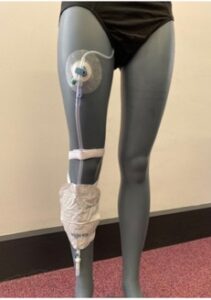
- Have a ‘day leg’ and a ‘night leg’. Alternate the leg on which your catheter fixation and urine collection bag are worn. We suggest that you wear your catheter and bag on one leg whilst in bed and swap everything to the other leg when you get up. This reduces the risk of the catheter always pulling to one side which could potentially cause injury to your meatus increasing the risk of a tear developing.
- Use a fixation device (below), if appropriate.
- Use a catheter valve (see below) if this has been recommended by a healthcare professional.
Ask your nurse or healthcare professional, do I need this catheter? Or, are there any alternatives that could be considered?
What is a catheter fixation device?
What is a catheter fixation device?
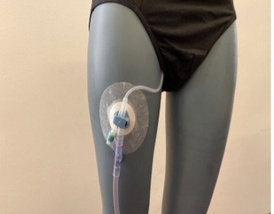
A catheter fixation device is designed to support your catheter by stabilising and securing the catheter to your upper thigh and to act as a shock absorber to prevent your catheter from pulling.
There are various types of fixation device so please discuss the most appropriate one for you with your nurse. When using a fixation device it should be worn high on your thigh and close to your catheter (see diagram below).
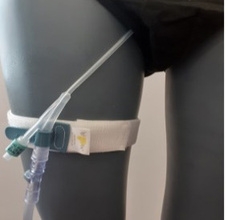
Ensure there is enough ‘slack’ between the device and the catheter to allow for your leg to move freely without causing tension to your catheter. If using a catheter fixation strap, it is essential that you readjust your strap if it slips down.
Sometimes there is insufficient catheter outside the body for a fixation device to be helpful. If you are concerned or unsure, please ask your nurse for advice.
Correct positioning with slack
Incorrect positioning with Catheter pulled tight
What is a catheter valve?
What is a catheter valve?
A catheter valve is a tap which fixes directly into the end of your catheter instead of a urine collection bag. For some patients these are a good alternative. The valve remains closed until you open the valve to allow urine to drain out of your bladder down the catheter and into the toilet or a collecting receptacle.
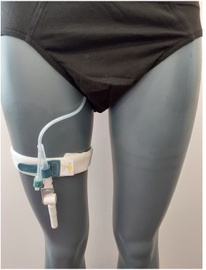
A catheter valve is very light and greatly reduces the risk of damage to your meatus. It can also be discreetly worn and tucked into your underwear.
A catheter valve can help to maintain bladder function, allowing the bladder to fill and empty normally.
If needed, catheter valves can be used with two litre drainage bags overnight. This can allow your urine to drain freely in to the bag overnight allowing you to sleep.
Ask your nurse about catheter valves to see if you are suitable, or for more information about catheter valves.
Catheter passport
Catheter passport
If you have a catheter in place, please ensure that you have a catheter passport. This contains other really useful information about catheter care and management.
If you haven’t been provided with a catheter passport, please ask your nurse.
Catheters and sex
Catheters and sex
Being intimate, having sex and masturbating are an important part of wellbeing for some men. This can still be achieved with a catheter. Hygiene before and after is imperative.
If your catheter is normally connected to a drainage bag you might consider asking your doctor or nurse for a catheter valve (see above).
Alternatively, you may want to be taught intermittent catheterisation so you can be catheter free.
Discuss this with your nurse.